The idea behind combining three things
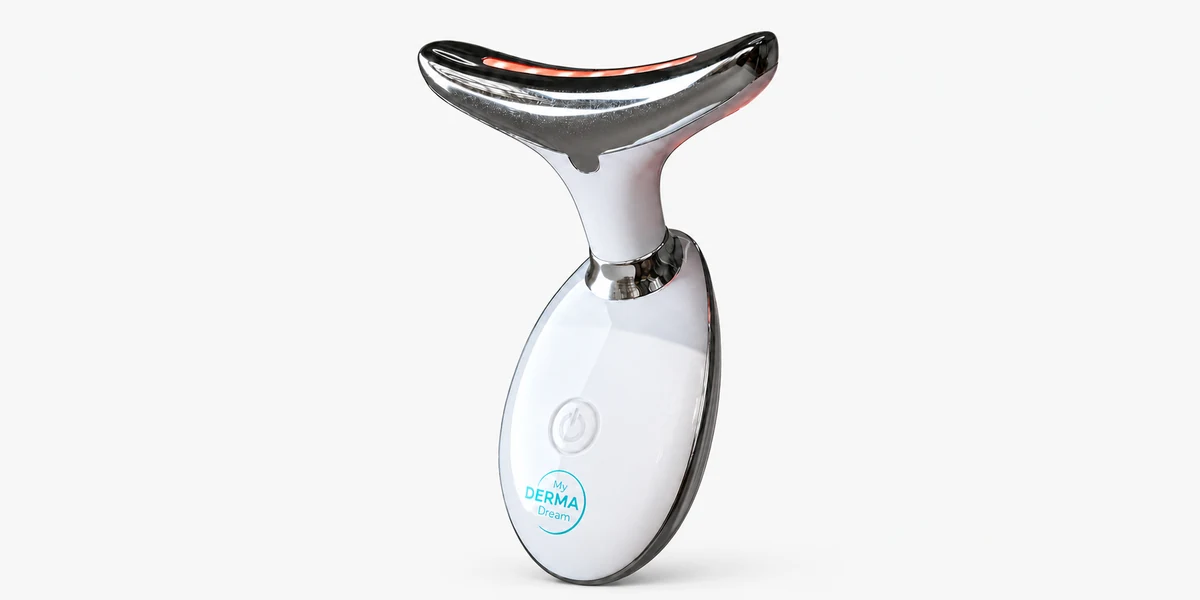
Most at-home skincare devices do one thing. An LED mask emits light. A vibrating wand massages. A warming tool raises surface temperature. The MyoGlow Derma Dream's premise is that doing all three at once, on a single head, in a single five-minute pass, is more practical than doing them separately.
That is a reasonable design goal and it is worth separating from a stronger claim the marketing sometimes implies — that the combination multiplies the effect. We have found no published trial testing that specific proposition for this device, so we treat the combination as a convenience feature: three routines you would otherwise skip, collapsed into one you might actually keep up.
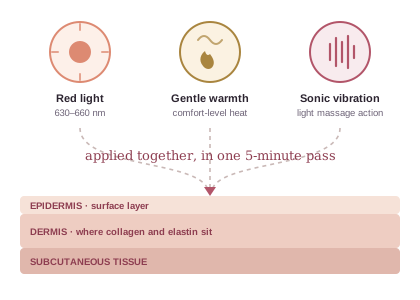
What is happening at each layer of skin
It helps to be concrete about where each of the three components is doing its work, because they operate at different depths and on different timescales.
At the surface — the vibration
Sonic vibration acts mechanically on the outermost layers and on the fluid sitting in the tissue just beneath. Gentle massage of this kind encourages interstitial fluid to move towards lymphatic vessels, which is the plausible mechanism behind the most commonly reported early effect: skin looking a little less puffy or heavy.
This is a genuine, observable effect. It is also a fluid effect — temporary, reversible, and unrelated to the structure of the skin or to body fat. It reverses if you stop.
Just below the surface — the warmth
Comfort-level heat dilates surface blood vessels and increases local circulation. Practically, this is why skin can look briefly brighter or pinker immediately after a session, and why the experience is usually described as relaxing.
Warmth is the least consequential of the three in terms of lasting change, but it earns its place for an unglamorous reason: it makes the routine pleasant enough to keep doing. A device that sits in a drawer produces no results at all, whatever it can do in principle.
In the dermis — the red light
This is where anything lasting would have to happen. The dermis is the layer that holds the collagen and elastin scaffolding that determines how firm and smooth skin looks, and it is maintained by cells called fibroblasts.
The proposed mechanism for red light in the 630–660 nm range is that it penetrates to this layer and is absorbed by mitochondria within those fibroblasts, modestly increasing their activity. If that translates to more collagen production, the visible consequence would be a gradual improvement in firmness and texture — emphasis on gradual, because collagen turnover is measured in weeks and months rather than days.
Why the order of effects matters
If you understand the three mechanisms, the reported pattern of results makes sense: puffiness shifts first (fluid, days), a temporary brightness appears immediately after sessions (circulation, minutes), and texture changes — if they come at all — arrive last (collagen, weeks to months). Anyone promising all three at once in the first week is describing something the mechanisms do not support.
The dose question nobody in the marketing addresses
In photobiomodulation research, the outcome depends heavily on dose — the combination of wavelength, output power, distance and duration. Research-grade equipment used in published studies is generally considerably more powerful than a consumer appliance.
Manufacturers of home devices rarely publish their output figures in a form that allows comparison with the literature, and this one is no exception. That is the single biggest honest uncertainty about any at-home LED product, and it is why we describe the technology as plausible rather than proven at this power level, in this form factor.
It is also why five minutes daily over months, rather than an hour once, is the sensible way to use it. Lower dose, higher frequency, longer horizon.
What the device does not do
- It does not remove or metabolise body fat. We make no weight-loss or contouring claim for it.
- It does not tighten skin mechanically, the way a surgical procedure does.
- It does not deliver anything into the skin. The serum sold alongside it is a topical product; the vibration helps spread it, nothing more.
- It does not treat any medical or dermatological condition, and it is not intended to.
The practical routine
- 1Clean, dry skin
Remove makeup and residue so nothing sits between the head and the skin.
- 2A thin layer of a water-based serum
Its job here is glide. The bundled serum does this; so does one you already own.
- 3Slow, overlapping passes — no pressure
Keep the head in contact and move slowly. Pressing harder does not increase the effect and can irritate skin.
- 4Five minutes per area, once daily
Set a timer. Longer sessions are not better; more days in a row is what matters.