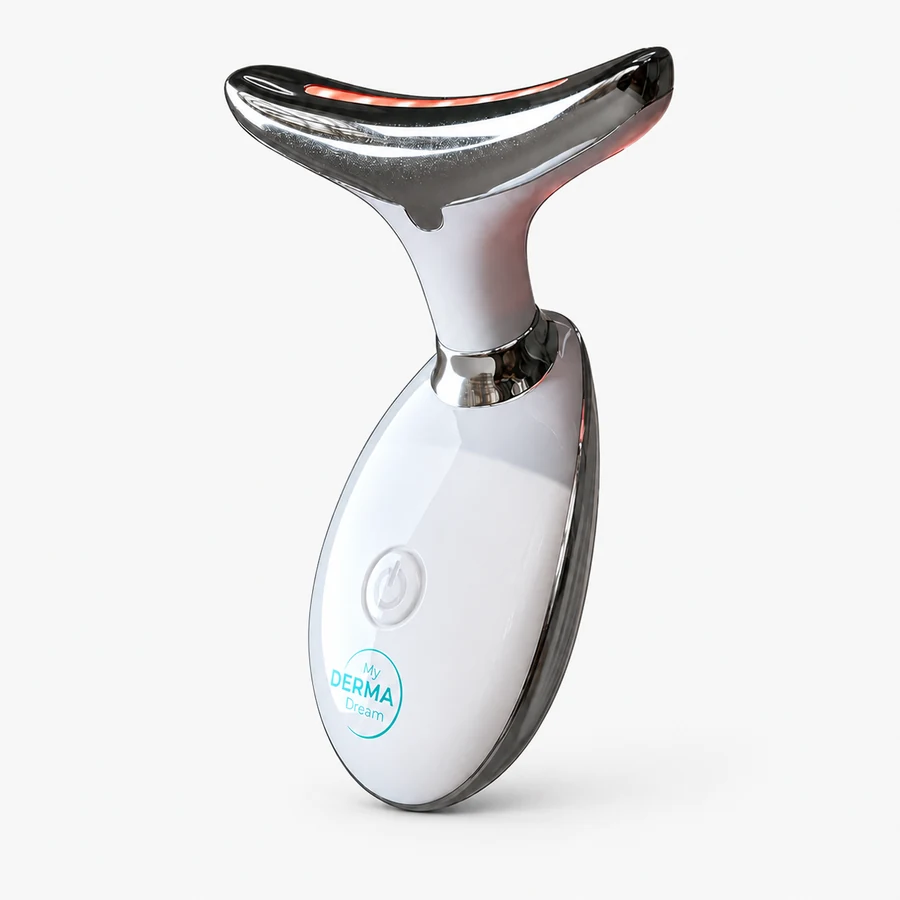
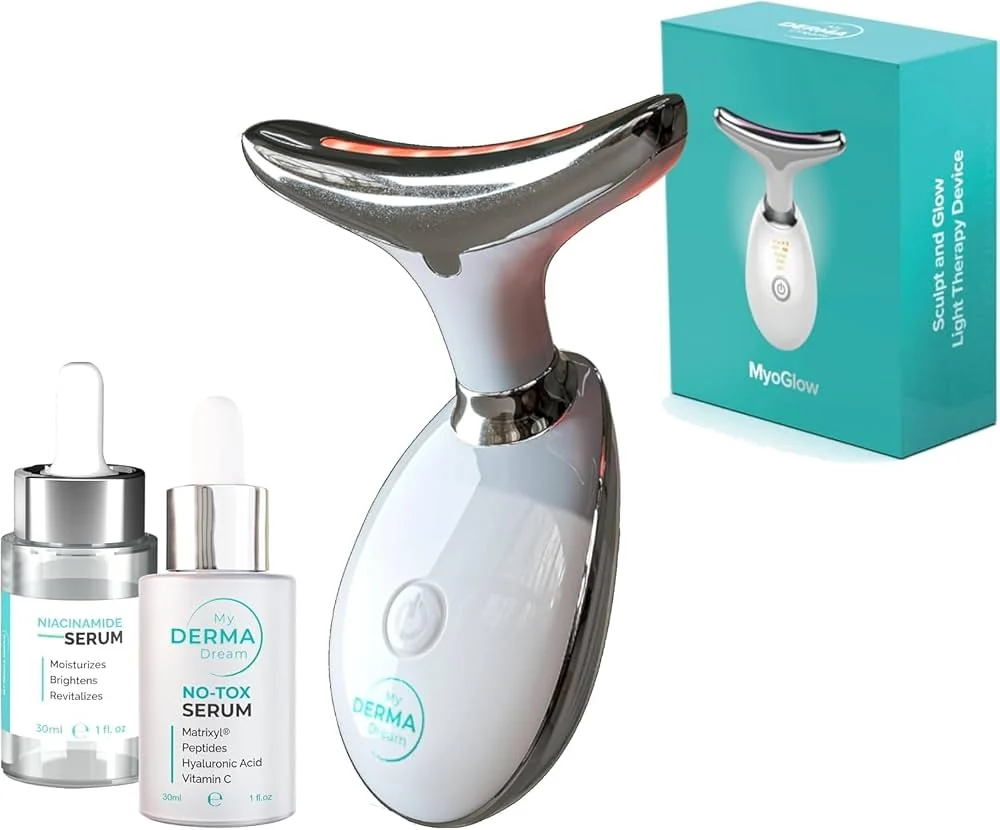
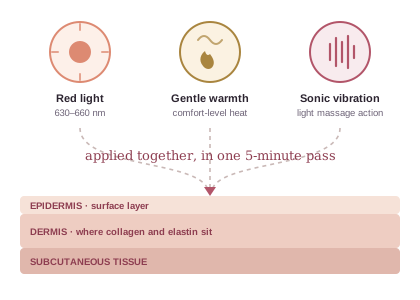
MyoGlow Derma Dream is a handheld at-home appliance that puts three things into one treatment head — red light, gentle warmth, and sonic vibration. This page explains what each of those is studied for, what the brand claims, what it does not do, and what the current pricing and guarantee terms are.
It is a cosmetic skincare appliance, in the same broad family as LED masks and handheld radiofrequency wands. What makes this one different is that it runs three modes at once rather than one at a time: light, warmth and vibration, on a single head that you glide slowly over the skin.
Most of the honest interest in a device like this comes down to one question: is there real science behind the parts? There is — for red light and for massage-assisted lymphatic drainage in particular. What the published research does not support is the more dramatic marketing language you will find on some pages selling it, and we have set that out plainly in the research section below.
If you want the short version: this is a low-risk, low-effort thing to try if you are curious, provided you buy it somewhere with a real return window and you treat the manufacturer's percentages as marketing rather than clinical data.
Scores are this site's own editorial assessment based on the manufacturer's published specifications, publicly available research on the underlying technologies, and the stated purchase terms. They are opinion, not measurement.
| Product | MyoGlow Derma Dream — handheld skincare device |
| Category | Cosmetic appliance (not a medical device) |
| Technologies | Red light (630–660 nm) · gentle warmth · sonic vibration, applied together |
| Session length | About 5 minutes per area, once daily |
| Common use areas | Upper arms, neck, jawline, décolleté, abdomen, thighs |
| Marketed for | The appearance of firmness, smoothness and texture on mature skin |
| Form factor | Palm-sized handheld; wing-shaped chrome head contoured for the neck and jaw |
| Included serums | “No-Tox” serum (Matrixyl®, peptides, hyaluronic acid, vitamin C) and a niacinamide serum, depending on bundle |
| Typical timeframe | Brand reports 2–4 weeks; research on red light generally runs 8–12 weeks |
| Guarantee | 90-day satisfaction guarantee — replacement or exchange, not a refund |
| Warranty | 1-year manufacturer warranty on the device |
| Shipping | Free US shipping; brand states 1–2 days processing, 3–5 days transit |
| Price range | $79 – $214 depending on bundle (see pricing) |
| Where sold | The brand's own online store — not in retail shops |
Being clear about this up front saves people money. A device like this is a decent fit for some situations and a poor one for others.
The brand's name for this combination is TriFusion. Stripped of the branding, it is three well-established consumer skincare technologies running at the same time instead of separately. Here is what each one is, described without the marketing.
Combining three mechanisms in one head is a convenience feature. It is not evidence that the combination produces a larger effect than the parts — that specific claim has not, to our knowledge, been tested in a published trial on this device.
These figures come from peer-reviewed studies on red light therapy as a technology. They were not produced by testing the MyoGlow Derma Dream, and they should not be read as predictions of what this device will do for any individual.
Some material promoting this device makes claims we could not substantiate, so we do not repeat them here. Specifically:
The brand publishes figures from its own customer surveys — for example, that 87% of users reported visibly firmer-looking skin. These are self-reported satisfaction numbers collected by the company from its own buyers, not independent clinical endpoints, and we present them here only as what the seller states. We have not verified them and neither, as far as we can tell, has anyone else.
Built from the manufacturer's own guidance alongside what published research on the underlying technology suggests. This is a general pattern, not a promise — some people notice very little.
Warmth and vibration increase local blood flow, so skin can look temporarily brighter or feel softer straight after a session. This is a short-term circulation effect and it fades. It is not yet a structural change.
If anything changes early, it tends to be fluid retention rather than firmness — which is consistent with the massage component doing the work. Skin can look a little less heavy or swollen, particularly around the jawline and upper arms.
Collagen turnover is slow. If red light is going to influence how firm or smooth skin looks, this is the window in which research generally starts to detect it — and the change is typically subtle and gradual rather than obvious.
Twelve weeks of consistent use is roughly the study standard. It is also comfortably beyond the 90-day return window, which is a good reason to take a dated photo at the start rather than relying on memory.
Remove makeup and any existing product from the area first.
The bundled “No-Tox” serum is designed to be applied before the session so the vibration works it into the skin. It is optional — a plain water-based serum performs the same practical function as a glide medium.
Move in slow, overlapping passes, keeping the head in contact with the skin. Do not press hard — pressure is not the mechanism.
Longer sessions are not better. Consistency across weeks is what matters, not intensity in any single session.
Take a photo of the area on day one, in the same light and the same position, then again at week four and week eight. Subtle gradual change is exactly the kind your own eye is worst at judging.
An honest comparison includes the things a home device does worse. Here is how the realistic trade-offs line up.
| Consideration | MyoGlow Derma Dream | Creams & serums alone | In-clinic procedures | Surgical options |
|---|---|---|---|---|
| Non-invasive | Yes | Yes | Varies | No |
| Needs no downtime | Yes | Yes | Sometimes | No |
| Done at home, no appointments | Yes | Yes | No | No |
| Reaches beyond the skin surface | Partly — light does | Limited | Yes | Yes |
| Strength of effect | Subtle | Subtle | Moderate–strong | Strongest |
| Requires ongoing daily effort | Yes — daily | Yes — daily | No | No |
| Typical upfront cost | $79–$214 one-off | Recurring | High, per session | Highest |
| Money-back window if unhappy | 90 days | Varies | No | No |
| Medical supervision involved | No | No | Yes | Yes |
This table compares categories in general terms, not specific competing brands. If you are weighing a clinical procedure, that decision belongs with a qualified practitioner — not with a review site.
The rating below and the comments that follow are published by the seller on its own store. We reproduce them as reported and have not independently verified them.
“My daughter recommended this to me. I have been using it in the evenings and I like how relaxing it is more than anything — I use it while I am watching something. I have noticed my neck looks a little less tired than it did.”
“Honestly this was an impulse buy and I expected nothing. Six weeks in and my skin does look better to me than it did — smoother, mainly. It is not dramatic but I am glad I bought it.”
“I got this as a gift and I mostly use it on my stomach. It is working better than I expected there. The one thing I would say is you have to actually do it every day, and I nearly gave up in week two.”
“Three weeks of using it on my neck. The crepey look has softened a bit. I had a different gadget before that did nothing at all, so this is an improvement, but I would not call it a transformation.”
Consumer LED and vibration devices are generally well tolerated, but “generally” is not “always”. These are the situations where it is worth a conversation with a professional before buying.
Nothing here is a substitute for advice from a qualified healthcare professional who knows your history. The MyoGlow Derma Dream is a cosmetic appliance. It is not a medical device and it is not intended to diagnose, treat, cure or prevent any disease or condition. If you have a health concern about your skin, please see a doctor rather than buying a gadget.
The three bundles the brand currently lists. Every option is the same device — the difference is how much of the optional serum comes with it. Prices are set by the retailer and can change at any time.
Prices shown are the amounts advertised by the retailer at the time of writing and are given for reference only. The price on the retailer's checkout page is the one that applies. This site does not sell the product, set its price, take payment, ship orders or process returns. Comparison prices refer to the manufacturer's own list price. If the price you see differs from the figure above, the retailer's page is correct and this page is out of date.
The brand advertises a 90-day satisfaction guarantee on the device alongside a one-year manufacturer warranty. One point matters more than any other here, and it is easy to miss: this is a satisfaction guarantee, not a money-back guarantee. The seller's stated remedy if you are unhappy is to make it right by replacing the device or exchanging the serums — not to return your money.
Our advice is simple and unglamorous — before you order, open the retailer's own guarantee page and read three things: exactly what remedy is offered, who pays postage if something has to go back, and how opened serums are treated. Guarantee terms can change without notice, and the retailer's page at the time of your order is the version that governs your purchase, not this summary.
The questions people most often ask before deciding whether a device like this is worth trying.